



PG Cert (Level 7) in Academic Practice for Transnational Education (Oct 2026 intake)
The Level 7 Certificate in Academic Practice for Transnational Education is recognised as equivalent to a Postgraduate Certificate (PGCert).
This course will equip academic and professional services staff from outside the UK, or relatively new to TNE in the UK, with the knowledge, skills, and intercultural competencies needed to deliver, support, and manage UK transnational education (TNE) programmes to UK standards.
The strong emphasis on quality assurance, pedagogical practice, curriculum design, student engagement, assessment integrity, as well as practicalities and cultural norms and expectations in the context of cross-border education will also appeal to those based within the UK.
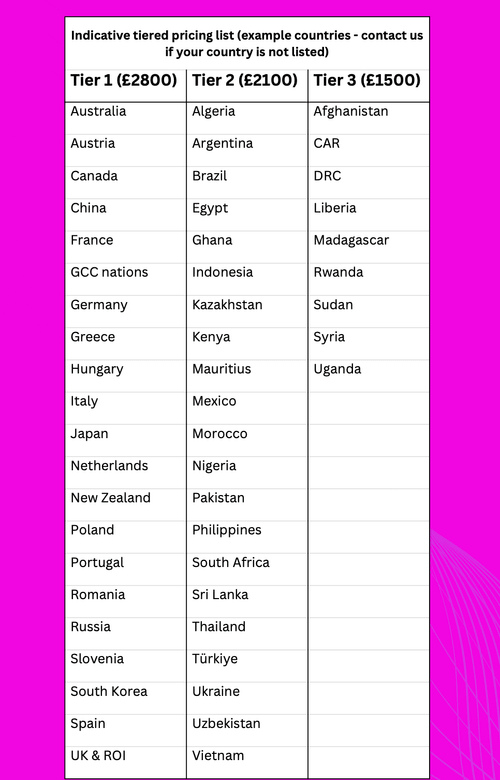
We use a tiered pricing model to make our programmes more accessible globally. Course fees are adjusted based on a learner’s country of residence, ensuring fairer access and greater equity of opportunity. If your country is not listed in the list, please contact us for the price.
Level of Qualification: Level 7 Certificate, equivalent to PGCERT
Unit Structure
- Unit 1: Designing Modules and Curricula for TNE (20 credits)
- Unit 2: Teaching, Learning and Assessment in TNE (20 credits)
- Unit 3: Internationalisation of Higher Education, Global Practice and Reflective Professional Practice in TNE (20 credits)
Learning Outcomes
Unit 1: Designing Modules and Curricula for TNE
- This unit enables participants to critically review, design and enhance modules and curricula for transnational education. It focuses on how NQF, learning outcomes, curriculum sequencing, assessment, student support, local relevance and delivery timetables work together in a specific TNE setting. Participants use a real module or curriculum area to produce a justified design or enhancement proposal that protects academic standards while making learning more meaningful, accessible and usable for learners studying their subject in English where English may not be their first language. The unit also supports participants to embed academic language development, employability, subject and graduate attributes, reflective practice and positive student identity within curriculum design.
- This unit enables participants to design, deliver and evaluate teaching, learning and assessment in TNE settings. It builds on curriculum design by focusing on how students engage with subject knowledge, academic language, assessment expectations and feedback in dual educational learning environments. Particular attention is given to teaching subject content through English to learners whose first language is not English, without reducing academic standards or subject challenge. Participants develop active, inclusive and culturally intelligent teaching approaches that help students participate, practise, build confidence, develop academic language skills and meet UK academic expectations within their own subject and institutional context. The unit also asks participants to weave relevant Sustainable Development Goals (SDGs), Education for Sustainable Development, AI, global citizenship and global competency into teaching content and practice where these are meaningful to the subject, the local context and students' future professional practice.
- This unit enables participants to critically examine TNE as a form of internationalisation of higher education and as a site of global academic and professional practice. It focuses on how academic qualifications, teaching delivery, student experience and partnership responsibilities are shaped by awarding and host institutions, different national systems, academic governance structures, student voice and staff co-teaching arrangements. Participants consider how internationalised higher education is enacted in practice through curriculum delivery, professional collaboration, cross-institution communication, quality processes and reflective enhancement. The unit supports participants to develop as professional reflective practitioners who can use evidence, theory, student and staff feedback, and sector expectations to evaluate their own role in TNE delivery and to strengthen ethical, context-sensitive and globally informed academic practice.
- How you will learn
- Group study
- Tutorials
- Seminars
- Independent study
- Small group learning
- Presentations
After you have completed the induction session, you will commence the web-based study component of the course. This will take place in our dedicated virtual learning environment (VLE) including online course materials, learning resources and regular tutorial support.
Our course provides an interactive learning experience and allows you to study at your own pace. You will be encouraged to interact with other course participants, and each module will involve group activities.
How you will be assessed
- Coursework
- Presentations
- Reflective review
- Written work
Each module will be assessed by coursework and a comprehensive written assignment, video-based assessment or equivalent.
Contact time and study hours
You should aim to study for a total of 600 hours (about 15-20% taught hours) throughout the course (8 months). The scheduling of the induction event will vary according to your cohort.
Entry requirements
As this course is designed for professionals in International Education, we would assess applicants on an individual basis.
Progression opportunities
Once you have completed the certificate course, you can carry on the credits to complete a Master's degree in a relevant subject.
Tuition fees
We use a tiered pricing model to make our programmes more accessible globally. Course fees are adjusted based on a learner’s country of residence, ensuring fairer access and greater equity of opportunity. If your country is not listed in the above list, please contact us to determine what payment tier you fit within.
Application Deadline: 30 Sep 2026
Accreditation
Learning Resource Network is a UK-based awarding organisation regulated by Ofqual.